ContentBite – better Shopify metafields app coming soon
Shopify Metafields Shouldn’t Feel Like a Puzzle
If you’ve ever opened Shopify’s metafields in the admin panel, you probably know the feeling.
You’re staring at a long list of fields with labels like “Heading”, “Subtitle”, “Button Text”, “Image”, and “Background Color”. You can edit the values, but you have no idea how they’ll actually appear on the storefront.
Will this image be a background or a thumbnail?
Is this heading the large one at the top or the small one above it?
What happens if you leave this field empty?
The only way to know is to preview the storefront, ask the developer, or search through documentation that often doesn’t exist.
For developers, this becomes a constant stream of questions. For merchants and content teams, it turns what should be a simple editing experience into trial and error.
I’ve experienced this on nearly every Shopify project I’ve worked on, and so have my clients.
The Problem Isn’t Metafields
Shopify metafields are incredibly powerful.
They let developers create flexible content models without hardcoding everything into themes. They make custom sections, landing pages, product content, and reusable components possible.
The problem isn’t the technology.
The problem is the editing experience.
Most metafield interfaces expose raw data instead of showing people what they’re actually building. The connection between the fields and the final design exists only in the developer’s head.
That gap is what we’re trying to close.
Building a Better Editing Experience
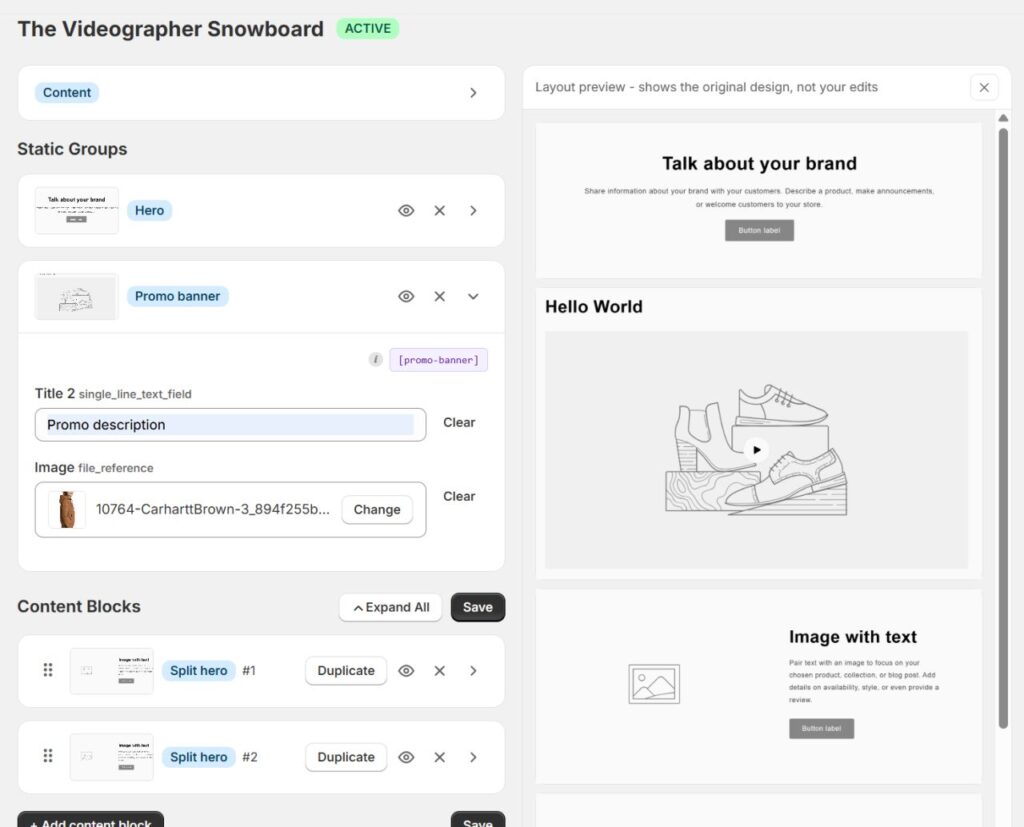
We’re currently developing a Shopify app that makes metafields visual, organized, and much easier to work with.
Instead of presenting users with a confusing list of inputs, the app provides context around every piece of content.
Group Related Fields
Rather than scrolling through dozens of unrelated fields, you can organize them into clearly named sections.
Need to edit a Hero banner? Everything related to that Hero lives together.
Need to update a FAQ? Those fields stay grouped as well.
The result is an admin experience that feels structured instead of overwhelming.
See the Design While You Edit
This is the feature I’m most excited about.
Instead of imagining what the content will look like, you see a design preview right next to the fields you’re editing.
You immediately understand where the title appears, how the image is used, where the button is placed, and how everything fits together.
No more guessing.
No more switching back and forth between the Shopify admin and the storefront.
Save Default Values
Many sections share the same starting content.
Instead of entering everything manually every time, you can save default values and populate new sections instantly.
It’s a small feature, but it saves a surprising amount of repetitive work.
Start with Presets
Sometimes you don’t want to build everything from scratch.
Presets let you choose from predefined layouts or content configurations, giving editors a solid starting point that they can customize afterward.
Hide Instead of Delete
We’ve all been there.
You remove content because you’re not using it right now, only to realize you need it again next month.
Instead of deleting everything, you can simply hide an entire section while preserving all of its content.
When it’s needed again, it’s already there.
Duplicate and Reorder Content Blocks
Another feature I use frequently is the ability to duplicate and reorder content blocks.
Need another feature card?
Clone it.
Want to move testimonials above the gallery?
Drag and drop.
This capability requires a small amount of custom development, but it’s straightforward for any Shopify developer to implement.
Built from Real Client Feedback
This isn’t an app that started as a business idea.
It started because I kept seeing the same frustration across project after project.
Clients didn’t struggle because they lacked technical knowledge.
They struggled because the interface gave them no context.
When I showed early prototypes to clients, the reaction was immediate.
They understood what they were editing without asking for explanations.
That was exactly the outcome I was hoping for.
Still in Development
The app is still under active development, and we’re continuing to refine the workflow based on real-world Shopify projects.
The goal isn’t to replace Shopify’s metafields.
It’s to make them feel like they always should have: visual, intuitive, and approachable for everyone who manages content.
Because editing a Hero section should actually feel like editing a Hero section.